
Static Phase Converters
Designed to operate 3-phase motors on single-phase power, these heavy-duty static phase converters produce approximately two-thirds of a motor’s horsepower rating. Ideal for motors that start quickly and infrequently, a static 3-phase converter allows the electric motor to continue running on single-phase power once the generated leg of power disengages after startup. A single-phase to three-phase static phase converter is for motor applications only. A static electronic phase converter will not run resistive or inductive loads because it does not produce a constant 3rd-leg power.

- Made in the USA
- BBB A+ Rating
- Free Sizing Guarantee
- 24/7 Free Lifetime Support
- Best Price Guarantee
Shop by Static Range
-

Standard Heavy-Duty
SPCThe SPC is our classic single-range static converter, with one fixed horsepower range per model. It uses high-voltage-rated start capacitors and a digital motor start relay to bring a 3-phase motor up to speed on single-phase power, then runs it at about two-thirds power once the motor reaches full RPM.
Best for
- light and medium motor loads
- a single known horsepower requirement
- motors that start easily and infrequently
-

High-Low
HLThe HL is a two-in-one unit: two static converters built into a single enclosure. A toggle switch on the top cover selects between high- and low-horsepower ranges, allowing a single unit to cover a wider range of motor sizes. It uses the same start capacitor and digital relay starting system as the SPC.
Best for
- running motors of two different horsepower sizes
- shops that switch between machines
- horsepower range flexibility from one unit
Static Phase Converter Features

Runs Most Motors at Two-Thirds Power
A static phase converter uses motor start capacitors to start a 3-phase motor on single-phase power. These capacitors are disconnected once the motor reaches full RPM, and the motor continues to run on the two single-phase lines. Two-thirds of the motor windings are energized, producing approximately two-thirds of the motor's power.
- Start capacitors energize the third winding to bring the motor up to speed
- Capacitors disconnect automatically once the motor reaches full RPM
- The motor then runs on the two incoming single-phase lines at about two-thirds power
- Best suited to light and medium motor loads that start easily and infrequently

High Voltage Rated Start Capacitors (330V)
High-voltage-rated start capacitors withstand higher voltage surges without failure. The capacitors are mounted with bleed resistors that help dissipate heat and voltage, extending the life of the components.
- 330V rating withstands higher voltage surges without failure
- Bleed resistors discharge heat and voltage from the capacitors
- Longer component life and more dependable starts

Digital / Electronic Motor Start Relay
Every NAPCco static converter uses a digital motor starting relay with a patented differential voltage sensing circuit that knows precisely when the motor is up to speed and when to disconnect the starting circuit. This is the same digital motor start relay used in our Pro-Line Rotary Phase Converters.
- Patented differential voltage sensing circuit times the disconnect precisely
- The same digital start relay used in our Pro-Line rotary converters
- Built-in over-voltage protection
- Safety time-out built in

Robust Start Circuit
Heavy-duty relays and contactors can handle high amperage during start-up. We use larger components because we want this unit to last as long as your machine does.
- Heavy-duty relays and contactors handle high start-up amperage
- Enlarged components chosen for long service life
- Rapid energizing capacitor starting for dependable start-up

Easily Accessible Wiring Junction Box
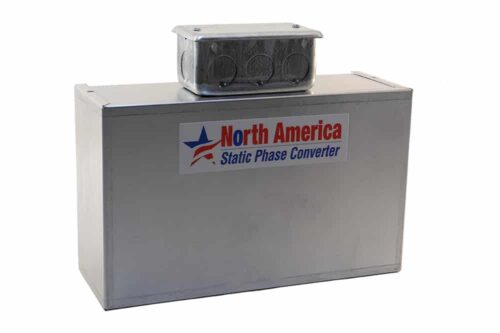
Top-mount junction boxes are easily accessible, making wiring a snap that can be completed in minutes.
- Top-mount junction box for quick access
- Wiring completed in minutes

Universal Mounting Options
Our static phase converters include hanging brackets that allow for wall or machine mounting.
- Hanging brackets included as standard
- Wall or machine mounting
Static Phase Converter Comparison Chart
Sizing a static phase converter comes down to horsepower. Find the model whose HP range covers your motor and that is your match. Because a static converter runs a motor at about two-thirds of its rated power and is built for motor loads only, choose a model that keeps your motor comfortably inside the range shown rather than right at the top of it.
Not sure which model fits your equipment? Call us at 877-545-2926 and we will size it with you.
Static Phase Converter FAQs
Yes, for the right loads. A static phase converter is a cost-effective way to run a three-phase motor from a single-phase supply, and it works well for simple motor-driven machines that start quickly and infrequently, such as a manual lathe, a drill press, a grinder, or a basic milling machine. It is the most affordable option when you only need to get a motor turning and can accept reduced running power.
A static converter energizes the motor only during startup and then drops out, so the motor runs at about two-thirds power on the two single-phase lines. It doesn’t deliver continuous balanced power, which makes it a poor fit for hard-starting or precision equipment. Avoid it on CNC machines and on hard-starting loads such as air compressors, pumps, and fans; those are better served by a rotary or digital phase converter.
A variable frequency drive (VFD) is a solid-state device that controls the speed of a single motor by varying its frequency and is usually fitted to a single machine, such as a fan, pump, or compressor. A static phase converter simply starts a 3-phase motor from a single-phase supply and lets it run at reduced power; it doesn’t control speed. If you need speed control on one motor, a VFD is the better tool, while a converter lets you run standard 3-phase equipment as designed.
NAPCco static converters range from 1/3 HP to 10 HP across the SPC and HL model lines, covering most small- and medium-power three-phase needs. Choose a single-phase to 3-phase converter sized so your motor sits within its rated range rather than at the very top.
The core parts are high-voltage-rated start capacitors, a digital start relay, and a robust start circuit built from heavy-duty relays and contactors. A static converter is not a solid-state phase device. Unlike a rotary converter, it has no idler: a rotary unit runs an idler motor to continuously generate the third leg, whereas a static converter uses its capacitors only to start the motor.
A static converter is built to start and run one motor at a time. It energizes a motor only at startup, so it cannot reliably bring several machines up to speed together or hold them there. If you need to run two or three machines at once, a rotary phase converter or digital phase converter sized for the combined load is the better choice.
No. A static converter runs a motor at about two-thirds of its rated power regardless of the converter’s size, because only part of the winding stays energized once the start capacitors drop out. Oversizing simply matches a larger motor’s starting demand; it does not restore full power. If you need full-rated output, choose a rotary or digital converter instead.
Need Help Selecting and Sizing the Right Static Phase Converter? Call Us!
Talk to an application engineer for free
Static converters are simple to size, but choosing the wrong unit for your load is a costly mistake. If you aren’t sure which model suits your equipment, talk to our application engineers before you buy. Every recommendation is backed by our sizing guarantee.