If you’re trying to power industrial equipment from a standard single-phase line, you’ve probably wondered: Does a phase converter change the voltage or frequency of the power it outputs? It’s a valid concern, especially if you’re running high-performance tools that rely on precise electrical input. The quick answer is no: a phase converter doesn’t alter frequency, and the voltage generally stays the same as your input power. Let’s look closer at how it works and what you can expect.
What a Phase Converter Really Does
A phase converter allows you to run three-phase machines, like lathes, mills, compressors, or pumps, from single-phase power. It does this by generating a third electrical phase to complete the three-phase circuit. This simulated three-phase power provides the performance industrial loads need without requiring a costly utility upgrade.
There are three main types of converters:
- Static converters start the motor and then drop out after startup.
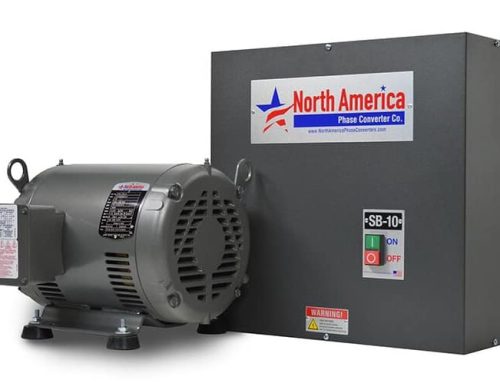
- Rotary converters use an idler motor to generate continuous, balanced three-phase power.
- Digital converters use a microprocessor to deliver highly stable and precise output.
Each type creates three-phase power in a slightly different way, but none of them change the frequency of your incoming power.
Frequency: Always Stays the Same
If your single-phase power supply is 60Hz, your phase converter will output 60Hz as well. Frequency affects how fast your motor runs, so keeping it consistent is crucial. Lowering the frequency to 50Hz would slow your motors down and cause excess heat, while raising it could damage internal components.
With a phase converter, the frequency doesn’t change. It simply replicates what’s already coming from your utility. That means your machines will run at the exact speed and performance level intended by the manufacturer.
Voltage: Usually Unchanged, Sometimes Adjusted
Voltage behavior depends on your setup, but generally, a phase converter outputs the same voltage as the input. If your line voltage is 240V single-phase, the converter produces approximately 240V three-phase power.
If your equipment needs 208V or 480V, you’ll need a transformer in addition to the converter. The phase converter itself doesn’t step the voltage up or down. It only creates the third leg of the electrical circuit.
Maintaining voltage balance is key for protecting motors and preventing uneven wear. Rotary and digital converters are designed to keep that balance within a few percentage points, ensuring stable operation and long equipment life. For rotary phase converters, voltage is balanced within 5%, while digital phase converters balance voltage within 2%.
Most phase converters are made for an input voltage of 208V to 245V. However, NAPCco makes a phase converter option designed for an input voltage of 460V-480V as well, meaning the output voltage would be approximately 480V three-phase.
For reference, you can explore detailed product options and voltage configurations in the phase converters section of North America Phase Converters’ website. We also offer an extensive line of single and three-phase transformers.
A Practical Example
Say you own a small metalworking shop with a few three-phase machines, like a 5 HP lathe and a 3 HP milling machine, but your building only has 240V single-phase power. By installing a rotary phase converter, you can create balanced three-phase power from your existing line.
The output voltage matches your 240V input, and the frequency stays steady at 60Hz. Your machines run smoothly, efficiently, and at full speed.
It’s important not to confuse a phase converter with a Variable Frequency Drive (VFD). A VFD can change frequency intentionally to control motor speed, but a phase converter simply replicates standard power with three balanced legs.
Choosing the Right Phase Converter
When buying a phase converter, start by matching it to your equipment’s voltage, horsepower, and/or amperage. Oversizing your phase converter (sizing larger than the combined total load) helps maintain voltage balance and gives you flexibility if you add more machines later on.
For most workshops and light industrial settings, rotary converters offer durability and performance at a reasonable cost. For sensitive CNCs or electronics-heavy systems, digital phase converters provide superior precision and balance.
If you’re not sure which one suits your needs, you can browse available models in the phase converters catalog to compare specs and get professional guidance. Additionally, our sizing resources provide a helpful starting point in figuring out what size phase converter will best suit your application.
Key Takeaway
So, does a phase converter change the voltage or frequency of the power it outputs?
No, it keeps the frequency exactly the same as your utility power (60Hz in the U.S.) and balances the voltage within a small percentage unless you use a transformer to modify it.
A phase converter simply provides balanced, reliable three-phase power so your equipment performs as designed, even without a true three-phase supply.
To find the best system for your setup, visit the phase converters page at North America Phase Converters and explore rotary and digital options built for performance, stability, and long-term reliability. Our experienced team of technicians can also help answer any phase converter and/or sizing questions you may have.