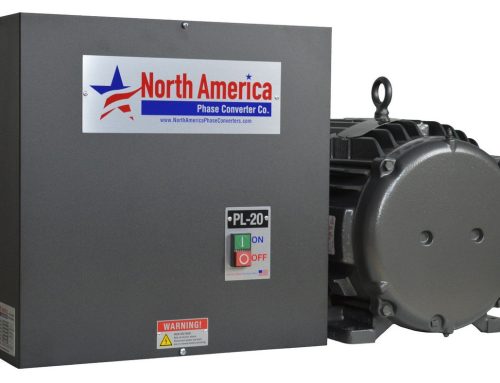

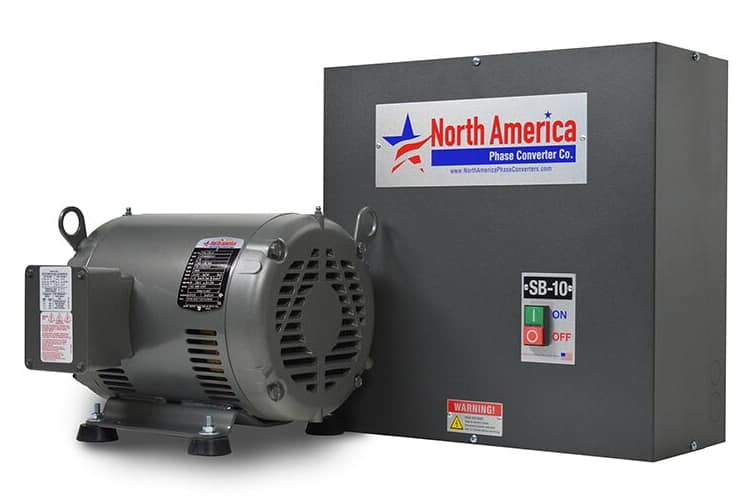
If you’ve spent any time researching phase converters, you’ve probably heard the term manufactured leg. It can also be referred to as the generated leg, the high leg, or the Delta output. It sounds technical, maybe even complicated. In reality, the concept is straightforward once you understand how phase conversion works.
Let’s break it down clearly.
The Basics of Three-Phase Power
Standard residential and many small commercial buildings receive single-phase power from the utility company. Three-phase power, on the other hand, uses three separate voltage sinewaves that are evenly spaced apart. This type of power is commonly required for industrial equipment such as CNC machines, mills, compressors, and heavy-duty pumps.
When three-phase utility service is not available or too expensive to install, a phase converter creates that third phase artificially. That artificial phase is what we call the manufactured leg.
What Is the Manufactured Leg?
In a single-phase system, you typically have two hot wires and a neutral. When using a rotary or digital phase converter, the converter takes the two incoming hot legs and generates a third one.
This third leg is not coming directly from the utility service; it’s created by the phase converter. That is why it’s called the manufactured leg.
You now have three hot legs instead of two. Together, they simulate true three-phase power and allow your equipment to operate as designed.
High-quality phase converters are engineered to create this manufactured leg in a stable and balanced way, especially in digital or rotary systems.
Why the Manufactured Leg Matters
The manufactured leg behaves slightly differently than the two utility-supplied legs. Because it is generated inside the converter, its voltage can vary depending on load conditions.
This is where phase converter quality and proper sizing become critical for a machine’s performance.
If the converter is undersized, the manufactured leg may experience voltage imbalance or fluctuations under heavy startup conditions. That imbalance can lead to:
- Motor overheating
- Reduced performance
- Nuisance breaker trips
- Shortened equipment lifespan
Modern digital and rotary phase converters are designed to actively regulate voltage and maintain better balance across all three legs, reducing these risks. Digital phase converters are especially equipped to handle voltage-sensitive equipment.
How the Manufactured Leg Is Identified
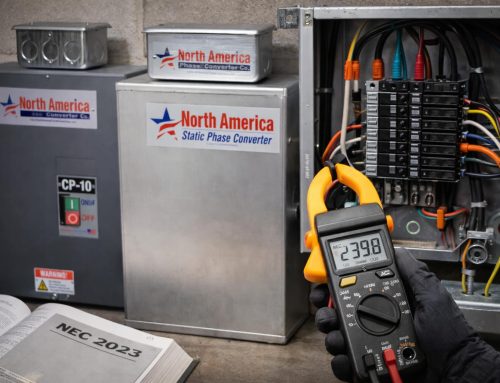
In most installations, the manufactured leg must be clearly identified according to electrical code. It is often marked with orange tape or orange insulation.
This identification is important because the manufactured leg should not be used for single-phase loads like control circuits in equipment and lighting. It is intended for three-phase motor loads only.
A licensed electrician will understand how to properly label and distribute the manufactured leg inside a three-phase panel.
Is the Manufactured Leg the Same as Utility Three-Phase?
No. Even though it allows your equipment to run as if it were connected to utility three-phase service, it is not identical.
Utility three-phase power provides three evenly balanced legs directly from the power company. A converter-generated manufactured leg is produced internally and responds to changes in load.
That said, when properly sized and installed, high-performance phase converters provide stable, reliable power suitable for most industrial applications.
For many businesses, this solution delivers professional-level performance without the high cost of upgrading to utility three-phase service.
When Should You Be Concerned About the Manufactured Leg?
In most properly designed systems, you do not need to worry about it.
Concerns usually arise when:
- The converter is undersized
- Multiple large motors start simultaneously
- Sensitive electronic equipment is connected
- Installation is not done correctly
- Improper wire sizing
Choosing the right converter and planning your load distribution prevents these issues.
The Practical Takeaway
The manufactured leg is simply the third phase created by your phase converter. It allows single-phase buildings to operate three-phase equipment without bringing in expensive utility upgrades.
It is not mysterious. It is not unstable when properly designed. It is a proven and widely used method of generating three-phase power.
When you select properly sized phase converters and install them correctly, the manufactured leg becomes just another reliable part of your electrical system. Contact North America Phase Converter Co., and we can help you find the right phase conversion system for your application.