

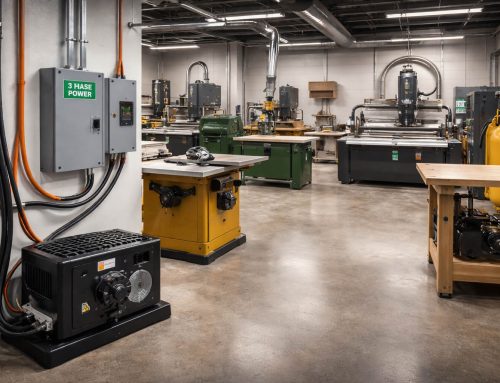
When a shop starts running industrial equipment, the power conversation usually comes up fast. Your machines need three-phase power, but the building only has single-phase. At that point, many shop owners assume calling the utility company is the easiest solution.
In reality, installing utility three-phase power is often far more expensive and complex than expected. Not because the power itself is inefficient, but because of what it takes to deliver it to your building and how it is billed over time.
Why Utility Three-Phase Power Gets Expensive Quickly
Utility three-phase power is not a simple service upgrade. It is a distribution level change. If three-phase lines are not already present at the property, the utility company must extend them.
That can mean new overhead lines, underground trenching, upgraded transformers, new metering equipment, and changes to the building’s service entrance. In most cases, the utility passes those costs directly to the customer.
Distance matters more than people realize. Even being a few hundred feet away from existing three-phase infrastructure can add significant cost. In industrial parks, the work is often manageable. In semi-industrial or rural areas, it can escalate fast.
Typical Cost Ranges
While pricing varies by region and utility provider, the numbers tend to follow similar patterns.
If three-phase power is already available nearby, installation costs often fall between $10,000 and $20,000. That usually covers transformer upgrades, metering, and service connection.
If infrastructure needs to be extended, costs commonly reach $30,000 to $60,000. In more complex situations involving long runs or underground construction, quotes over $100,000 are not unusual.
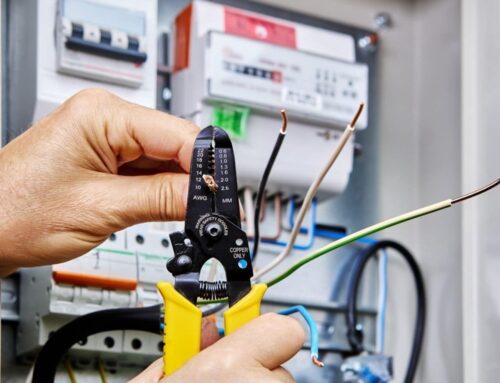
These figures also do not include internal electrical upgrades. Many buildings require new panels, feeders, disconnects, and code compliance updates before three phase service can even be energized.
The Hidden Cost of Demand Charges
Installation is only part of the expense. Utility three-phase power is usually billed with demand charges.
Demand charges are based on the highest level of power your facility pulls during a billing cycle. Even a brief startup event can set the demand for the entire month.
Large motors, CNC machines, and compressors draw high inrush current at startup. That spike may last seconds, but it can significantly increase the monthly bill. Over time, demand charges alone can add thousands of dollars in operating costs.
How Motor Behavior Impacts Utility Costs
Three-phase motors naturally draw several times their rated current during startup. Utilities must size transformers and distribution equipment to handle those surges, which is one reason installation costs are high.
From the customer side, those same startup events drive peak demand billing. Soft starters and VFDs can reduce the impact, but they add upfront cost and complexity to the system.
Because of this, many shops start looking at alternatives like phase converters instead of modifying the utility connection itself.
Comparing Utility Power to Phase Conversion
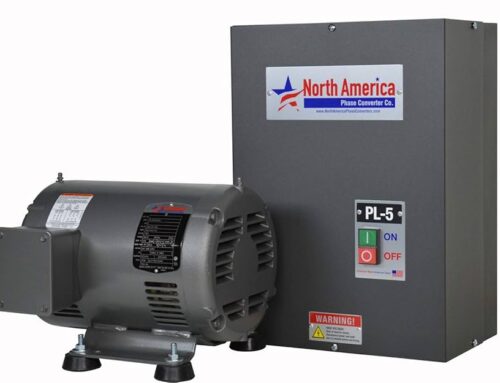
From a cost standpoint, the difference is often substantial. A properly sized rotary or digital phase converter system typically costs a fraction of a utility three-phase installation.
There are no construction fees, no long approval timelines, and no separate demand charges tied specifically to three-phase service. Power continues to be billed as single phase. Additionally, installation is less time-consuming.
Modern phase converters are engineered to manage startup loads, maintain phase balance, and deliver stable voltage under real shop conditions. Digital systems, in particular, offer tight voltage control for CNC machines and other sensitive equipment. Additionally, a properly-sized rotary or digital converter can power multiple pieces of equipment at the same time.
Flexibility Matters More Than Most People Expect
One overlooked downside of utility three-phase power is permanence. Once you pay for the upgrade, that investment stays with the building.
If the shop moves, downsizes, or changes equipment, the money spent on infrastructure is gone. Phase conversion systems offer flexibility. Capacity can often be adjusted, systems can be relocated, and expansions do not require starting over.
That flexibility is a major reason many growing shops choose phase converters instead of committing to utility upgrades early on.
When Utility Three-Phase Power Makes Sense
Utility three-phase power is not the wrong solution in every case. Large facilities with continuous, high load across many machines can justify the investment. For those operations, long term stability outweighs the cost.
For most small and mid sized shops, fabrication businesses, farms, and startups, the economics rarely line up the same way.
The Practical Takeaway
Utility three-phase power is typically expensive because it requires permanent infrastructure, demand based billing, and long term commitment to a specific location.
Before moving forward, it’s worth comparing the full cost over time, not just the initial quote. In many cases, phase conversion provides the performance machines need without the financial and operational burden of utility upgrades.
The smarter decision usually comes from understanding how power behaves in real conditions, not just how it looks on paper.


Leave A Comment