
Static Phase Converters 101
A static phase converter uses start capacitors to start a three-phase motor on single-phase power, then runs it at about two-thirds of its rated horsepower. Built for light and medium motor loads.

What is a static phase converter?
A static phase converter generates three-phase power when starting a motor. It assists only during startup, so once the motor is up to speed, it runs at reduced power rather than at full rated horsepower.
Designed for: Light and medium starting and running motors.

How does a static phase converter work?

A static phase converter consists of one or more start capacitors and a start relay. The start capacitors produce voltage across the motor’s third winding during start-up. Once the motor is up to speed, these capacitors are disconnected from the motor winding. The motor load is now running on just the two single-phase power lines (in essence, the motor is single-phasing). There is at least a 1/3 power loss of the motor horsepower.
NAPCco offers static converters in two versions: the Standard Heavy-Duty (SPC), with classic horsepower ranges and the High-Low (HL), a two-in-one unit with a toggle switch that selects between high and low horsepower settings.
Static vs Rotary Phase Converters: What’s The Difference?
Both a static phase converter and a rotary converter handle phase conversion, making 3-phase power from a single-phase supply, but they do it in very different ways, and the right choice comes down to your loads and how hard you run them.
| Static Phase Converter | Rotary Phase Converter | |
|---|---|---|
| How it works | Start capacitors assist the motor during startup, then drop out | Uses an idler motor and control panel to create a true third leg continuously |
| Power output | Runs at about two-thirds of rated horsepower, less compared to rotary | Full-rated horsepower with cleaner power quality and steadier voltage balance |
| Load types | Light and medium motor loads only | Motor, resistive, and inductive loads |
| Multiple machines | One motor load at a time | Runs one or several pieces of three-phase equipment at once |
| Best for | Occasional or light-duty single-machine use | Full-time shop use and mixed or hard-starting loads |
| Capacity range | 1/3 HP to 10 HP | 3 HP to 100 HP |
| Relative cost | Lowest, and the most cost-effective option | Mid-range |
| Shop | Shop Static Converters | Shop Phase Converters |
Which type of static phase converter do I need?
Setting: Hobby shop/home garage
Typical Equipment: Drill press, table saw, milling machine
Why a static converter suits it: Static converters are for light and medium motor loads only and are designed to run motors at 2/3 of their full rated power. Because equipment cannot run at full power on a static converter, they are mainly used in hobby shops or for equipment used intermittently. For equipment that operates under heavier loads or runs for extended periods, a rotary phase converter is usually the better choice, which runs equipment at full-rated power.

Important
When not to use a Static Phase Converter
A static phase converter is for motor loads only and will start light and medium motor loads. Do not use a static phase converter with the following applications: welders, heaters, two-speed motors, air compressors, pumps, fans, CNC machines, plasma cutters, refrigeration trucks, blowers, large flywheels, large lathes and motors older than 1965.
What’s the difference between a static phase converter and a digital phase shifter?
A “digital phase shifter” is just a static phase converter with a new name!
It’s still capacitor-based, same as every static converter on the market, including ours. No electronics or microprocessor is documented behind the name. “Digital” describes the marketing, not the mechanism.
The one real difference is in how the capacitors are used. Instead of start capacitors that disconnect once the motor reaches speed, a digital phase shifter keeps capacitors in the circuit as run capacitors. That’s why the unit can’t produce any three-phase output until the motor is already turning under its own power. It needs the motor running before it can generate anything. That’s the opposite of what you’d expect from something marketed as an upgrade.
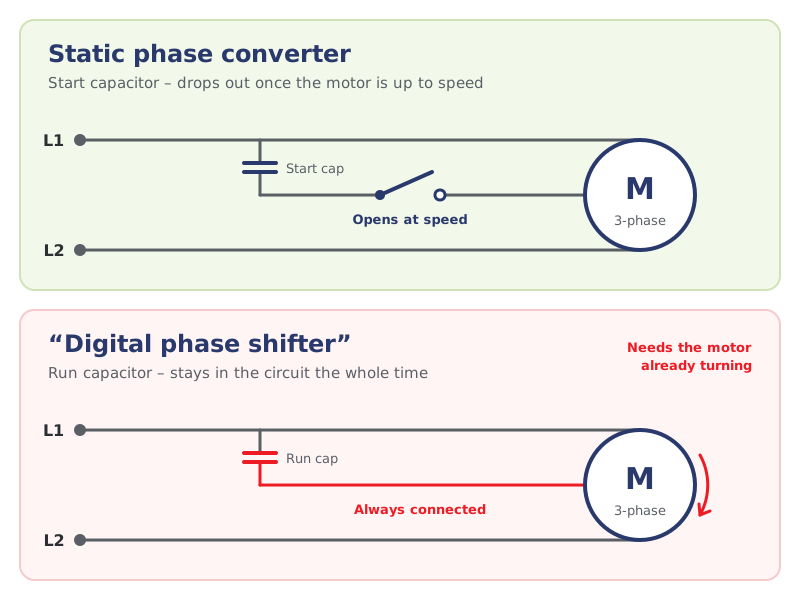
Despite that, these units get marketed for pumps, compressors, and fans. Those are loads we don’t recommend running on a standard static converter, and for good reason. Leaving capacitors engaged longer doesn’t turn a static converter into a continuous, full-rated power source.
If you need real three-phase power for equipment like that, a rotary phase converter delivers full-rated horsepower continuously. A relabeled static converter doesn’t.
How do I size and install a static phase converter?
Static phase converters are quick to wire in between your single-phase power supply and your 3-phase motor, and most installations can be completed in minutes. Static converters are sized based on the horsepower of the motor being started, and the converter should match the motor’s rated horsepower. For the best performance and motor protection, be sure to select a static converter that is properly sized for your application. Follow the wiring diagram below, or call 877-545-2926, and we will walk you through sizing the static converter to its rated capacity and installing it for your setup.
