Installing a phase converter is not just about getting your machines running. It also has to be done safely and in compliance with electrical code. Whether you are powering a single machine or feeding a three-phase panel, understanding the electrical code requirements for phase converters is essential.
Let’s walk through the key areas that matter.
NEC Compliance Is the Starting Point
In the United States, electrical installations must follow the National Electrical Code (NEC). While the NEC does have a specific section exclusively for phase converters, several articles can still apply depending on how the system is installed.
Common NEC articles that typically apply include:
- Article 430 for motors and motor circuits
- Article 455 for phase converters
- Article 250 for grounding and bonding
- Article 409 if industrial control panels are involved
State and local jurisdictions may adopt additional amendments, so always check with your local authority having jurisdiction.
Proper Overcurrent Protection
Phase converters must be protected by properly sized circuit breakers or fuses.The input breaker selection must take into account the size of the phase converter and the loads running after it.
Key considerations include:
- Breaker size based on input current
- Motor branch circuit protection
- Proper disconnecting means
Improper overcurrent protection can result in nuisance tripping or unsafe overheating conditions.
Modern phase converters are designed with clear installation guidelines to help electricians size protection correctly.
Grounding and Bonding Requirements
Grounding is one of the most critical code requirements.
The converter must be properly grounded according to NEC Article 250. This includes:
- Equipment grounding conductor sizing
- Proper bonding to the service panel
- Correct grounding of the enclosure
Failure to ground correctly can create shock hazards and equipment damage.
Identification of the Manufactured Leg
When using a rotary or digital phase converter, the manufactured leg must be clearly identified. In some jurisdictions, it is marked with orange tape or orange insulation.
This identification is required because the manufactured leg should not be used for single-phase loads such as lighting or control circuits. It is intended strictly for three-phase loads.
Clear labeling prevents miswiring and improves safety during future maintenance.
Properly engineered phase converters include documentation that outlines how the manufactured leg should be identified and distributed.
Panel and Distribution Considerations
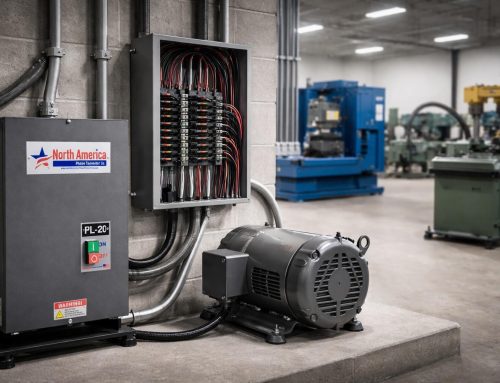
If the converter feeds a three-phase panel, additional code requirements apply.
The panel must be:
- Properly rated for the system voltage
- Clearly labeled as phase converter-fed
The manufactured leg must not be used to supply single-phase branch circuits unless specifically permitted and engineered.
A licensed electrician should ensure the distribution system meets both NEC requirements and local code amendments.
Enclosure and Environment
The converter enclosure must be suitable for its installation environment. For example:
- NEMA 3R rated enclosures for dusty or outdoor areas
- TEFC rated motors for outdoor use
- Proper ventilation for heat dissipation
- Secure mounting
Environmental factors can affect both safety and code compliance.
Utility and Inspection Requirements
In most cases, a permit is required before installation. After installation, an electrical inspection may be necessary to confirm compliance.
Commercial facilities often face additional review from insurance providers. Documentation showing that properly a rated phase converter was installed according to manufacturer guidelines can simplify this process. Some states or local jurisdictions may require a phase converter to be UL-listed as well.
Why Professional Installation Matters
Even though phase converters are widely used in shops and industrial environments, installation requires careful planning and consideration.
Electrical code compliance protects:
- Your equipment
- Your building
- Your employees
- Your business liability
A licensed electrician familiar with motor circuits and phase conversion systems should perform the installation.
The Bottom Line
Electrical code requirements for phase converters focus on safety, proper protection, grounding, and clear identification of the manufactured leg.
When installed according to NEC standards and local codes, phase converters provide a safe and reliable way to power three-phase equipment in single-phase facilities.
The key is choosing the right equipment, following manufacturer instructions, and ensuring the system is installed professionally and inspected properly.