As your shop grows, your power needs usually grow with it. Maybe you started with one three-phase machine running on a phase converter. Then you added another. Now you’re thinking ahead and asking:
Can a phase converter output be wired into a three-phase panel?
Yes, it can. In fact, many professional shops use this exact setup. The key is proper sizing, correct installation, and smart load planning. A three-phase panel is also known as a three-phase load center or circuit breaker panel.
What Happens When You Feed a Three-Phase Panel
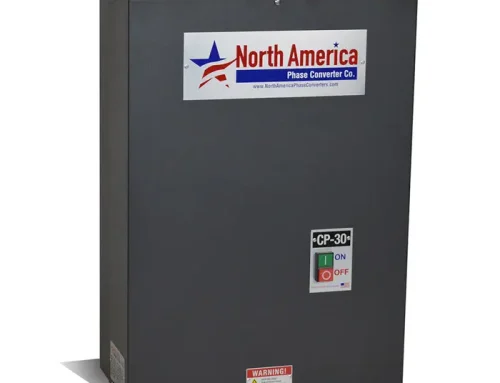
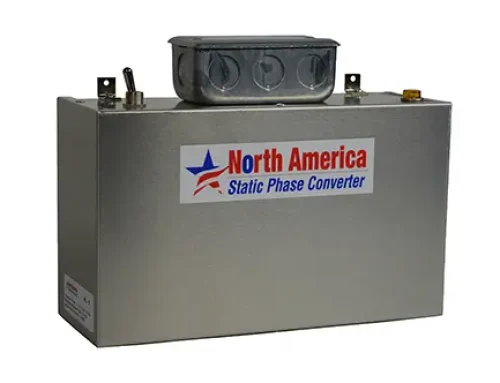
A phase converter takes single-phase utility power and generates a third leg so that three-phase equipment can operate. When the phase converter is connected to one machine, the system is simple.
The setup is different with multiple machines. When the converter feeds into a three-phase distribution panel, it becomes a centralized power source. The panel then distributes three-phase power to multiple machines through individual circuit breakers.
This setup creates a cleaner electrical layout and makes future expansion easier. Instead of rewiring every time you add equipment, you simply add a circuit breaker to the panel.
Well-designed rotary and digital phase converters are designed specifically to support these multi-machine configurations when properly sized.
Why Many Shops Choose This Configuration
Feeding a panel from a phase converter makes sense when:
- You have multiple three-phase machines
- Equipment runs simultaneously
- You want organized breaker protection
- You plan to expand operations
Instead of running separate lines from the converter to each machine, the panel acts as a distribution hub. This keeps wiring organized and simplifies troubleshooting.
Modern phase converters are commonly used in fabrication shops, machine shops, automotive facilities, and woodworking operations for exactly this reason.
Sizing Is Where Most Mistakes Happen
Properly sizing your phase converter is critical.
You must account for:
- The largest motor that the phase converter will start
- All of the loads that may run at the same time
Adding up motor horsepower and/or equipment amperage is not enough. Motor startup demand can be significantly higher than the running load. If the converter is undersized, you may see issues like voltage imbalance, overheating, nuisance tripping, or shortened motor life.
Oversizing the system is safer than undersizing. Digital or rotary phase converters are especially effective in panel-fed applications because they provide better voltage balance across multiple loads. To get help sizing a phase converter, use NAPCco’s sizing calculator or call us directly to talk to an application engineer.
Can Multiple Machines Run at the Same Time?
Yes, as long as the total demand stays within the converter’s HP and/or amperage rating.
For example, if you have two 10 HP machines, the total demand would be 20 HP. For rotary phase converters, it’s usually recommended to double the total horsepower or amperage rating when sizing. Therefore, a 40 HP rotary converter would likely work in this case. Additionally, hard-starting loads may need additional legroom to account for the surge of inrush current during startup.
Many shops manage surges by staggering startups or ensuring high-inertia equipment does not engage at the same moment. Smart load management protects both the converter and the connected equipment.
Is This the Same as Utility Three-Phase Service?
No. A converter-fed panel is not identical to utility-supplied three-phase power. The manufactured leg behaves differently under certain load conditions.
However, properly sized digital or rotary systems provide stable, balanced power suitable for most industrial machinery, including CNC equipment, mills, lathes, compressors, and pumps.
For many businesses, installing a phase converter and feeding a panel is far more affordable than bringing in utility three-phase service, which can be extremely expensive depending on location and infrastructure.
Installation and Safety
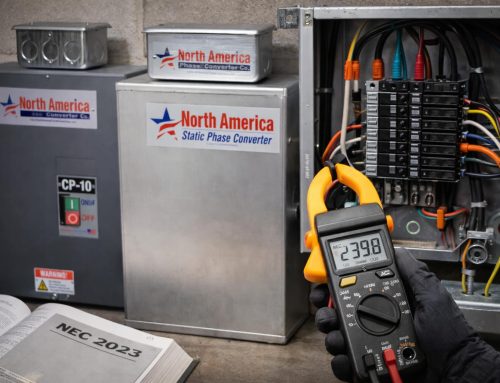
When wiring a converter into a three-phase panel, you need:
- Proper input breaker protection
- Correct wire sizing
- A properly rated three-phase panel
- Grounding that meets local, state, and national electrical codes
The manufactured leg must be properly identified according to code requirements. A licensed electrician should install the setup.
The Practical Answer
So, can a phase converter output be wired into a three-phase panel?
Yes. When sized correctly and installed properly, it is a reliable and widely used solution for shops operating multiple three-phase machines on single-phase power.
With the right planning and the right phase converters, you gain flexibility, room to grow, and professional-level power distribution without the cost of upgrading your utility service. North America Phase Converter Co.’s experienced application engineers can help you find the right phase converter and panel setup for your needs.